Food is Life.
I once stood on a busy street corner in Puebla, Mexico. A market day, a late October morning, battleship-gray skies overhead. I watched women – young, old, rich, poor―lugging string bags or baskets laden with food, hurrying home to cook almuerzo, lunch.
I couldn’t get the thought out of my head: Food is life.
Life revolves around the growing of food, the eating of it, the cooking of it. It’s the saga that drives everything, including history. As Kristine Kowalchuk so perceptively puts it in Preserving on Paper (2017), “They [bread and wine] mean, literally life over death. Medieval and Renaissance people, because of their connection to the land and cyclical conception of time, perceived this deeper literal meaning.”
The script of life is all about eating to survive, to go on living. Everything humans do ultimately circles around food and the getting of it. That day I deemed this truism an epiphany. And I still do.
Food. Such a small word with such a large meaning.
What happened after 1492 changed the world forever. Empire happened, fueled by the voyages sponsored by the Spanish crown and later by England’s Virgin Queen Elizabeth I. Adding to the richness of this story is of course, a subtext of cultural clashes, political power, and greed for gold and spices. And hegemony.
Yet something else took place, much more subtly. The diffusion of foodstuffs from across the oceans, from all the fields and forests and rivers of newly discovered lands, all that changed the world every bit as much as did all the political jockeying in the royal courts of Europe.
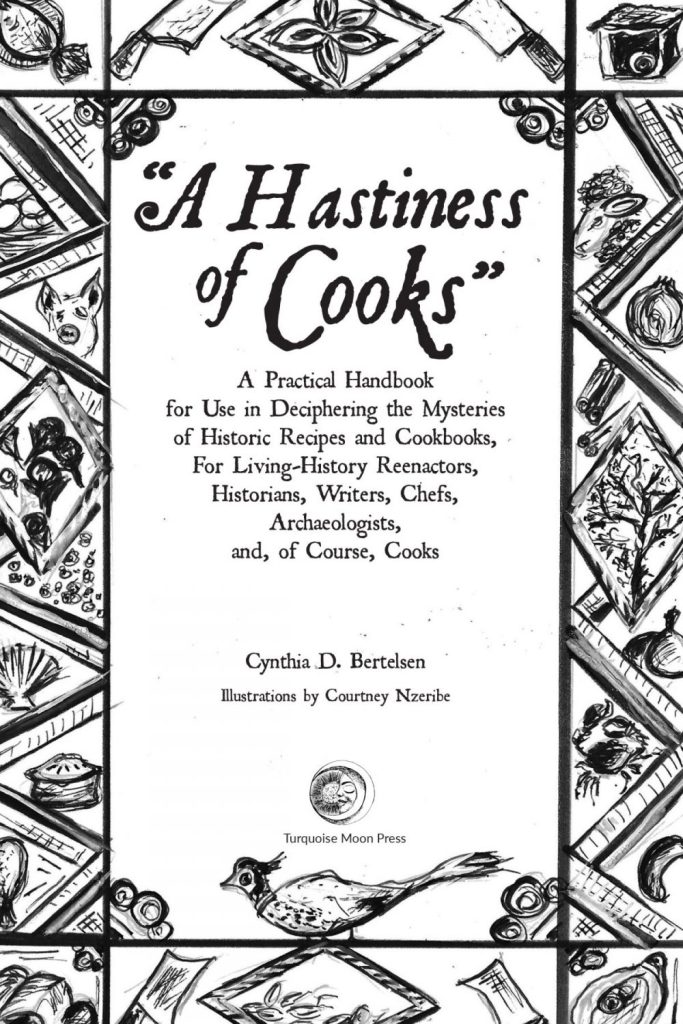
My award-winning handbook, “A Hastiness of Cooks,” takes you on a whirlwind tour of historic cookbooks dating from the earliest days of cookbook writing in Europe, circa 1390, with the emergence of the English manuscript, The Forme of Cury, and the Catalan Llibre de Sent Soví. I include medieval and colonial-era Spain, because Spanish cookbooks tend not to be analyzed and studied as much as those originating in England or France or Italy. But my approach is fitting. Over a period of almost 800 years, Islamic rulers controlled much of what is now modern Spain. Influential thirteenth-century Arabic manuscripts such as Kitâb al-Tabîkh fi’l-Maghrib wa’l-Andalus fi’asr al-Muwahhidin (Anonymous Andalusian) and Fudalat al-Khiwan (The Delights of the Table) guided Spanish cookbook authors for centuries. The Arab influence on Spanish cuisine, and indeed much of medieval cooking, is undeniable.
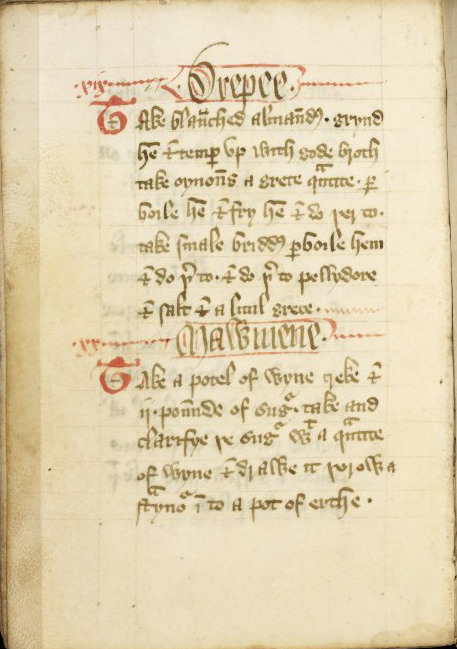
I regard cookbooks to be primary sources as much as are culinary manuscripts or other materials. My focus here is on manuscripts and books ranging from medieval times to the end of the 1700s. All reveal information useful to archaeologists, historians, writers, reenactors, living-history interpreters, chefs, home cooks, and anyone intent on deciphering and recreating the intricacies of food history and culture.
What you’ll learn from “A Hastiness of Cooks“:
- What cookbooks teach about past social, economic, political factors
- Why it’s important to know about the history of cookbooks
- How to read, interpret, and follow recipes from period cookbooks
- Where to find information for further study
Spain ruled the New World from 1492 to 1899. At one point, England controlled 25% of world’s land mass and the people therein. These empires molded the lives of both elites and ordinary people. Both of these culinary legacies still shape the historical landscape, in much the same way that a river flows and cuts through rock, carving new formations.
It’s quite a story!
___________________
*What is the meaning of “A Hastiness of Cooks”?
A word game, popular in the great households of late medieval England, had at its heart the creation of collective nouns. In the lists of these names, alongside the laughter of hostellers, the glossing of taverners, the promise of tapsters and the fighting of beggars, were household references – a carve of pantlers (who looked after the bread), a credence of servers, (‘credence’ was the process of tasting or ‘assaying’ foods against poison), a provision of stewards of household – and a hastiness of cooks. The pressures of the medieval kitchen, the precipitate hurry and irritation of the cooks are all captured in the medieval meanings of ‘hastiness’.
~ C. M. Woolgar, The Culture of Food in England, 1200 – 1500
“A Hastiness of Cooks” was published in 2019, and, in 2020, won Best in the World in the Culinary History category at the Gourmand World Cookbook Awards.


Thank you, Dianne!!
Dear Cynthia Thank you for the post about cookbooks relating to history and how food ‘travels’ from one area of the World to the other including ingredients and those who use them. It is ironic that the dishes we eat here in the US are mostly, in my opinion, brought by immigrants. They bring the spices and grow the ingredients. I remember in Goleta in the mid-70s the development of small farms by Hmongs who were escaping Communist extermination. They grew vegetables and herbs in California unknown at that time to many. Lemon grass and Chinese pea pods were in some markets and now are expected items. The Columbia Exchange , as you note, started in 1492. I got in trouble in culinary school by relating history and food in one of our final papers. The instructor and I came almost to blows about the fact that the Vikings saw Normandy as a great place to raise cattle and sheep which resulted in the roots of French cheesemaking in that area and therefore at least three major cheeses were created. This industry was recreated by French explorers in Canada, etc. Every time I have a sliver of Brie or Camembert I think about that, seriously! Dianne. PS. The instructor was asked to resign. Apparently another class reported abusive behavior.