By God, if women had written stories,
As clerks had within here oratories,
They would have written of men more wickedness
Than all the mark of Adam may redress.
~ Geoffrey Chaucer
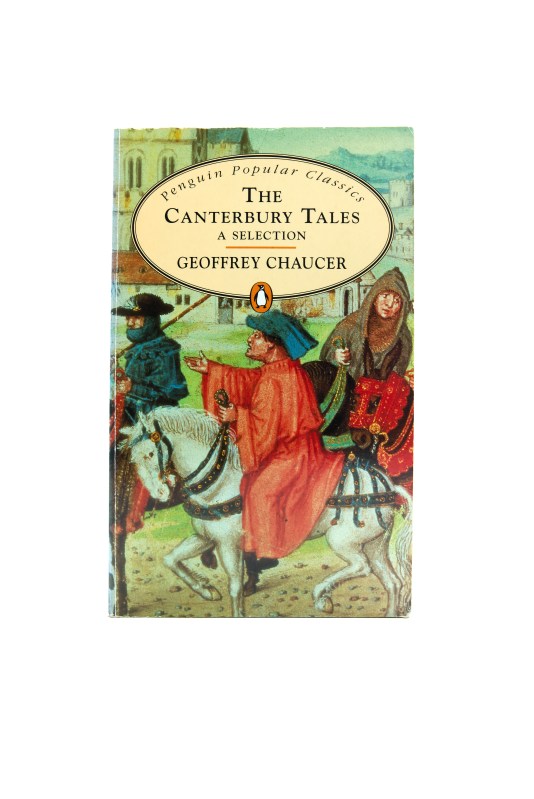
Somehow, I managed to get through many years of schooling without ever cracking open a copy of Geoffrey Chaucer’s The Canterbury Tales. Fleeting references to it sprung from other pages, though, in classes on medieval history. Unfortunately, Middle English quotes requiring a dictionary stopped me from pursuing this remarkable book, the first written not in the scholarly Latin of the time but rather in the words spoken by Everyman on the streets, in shops and in homes, both high and low.
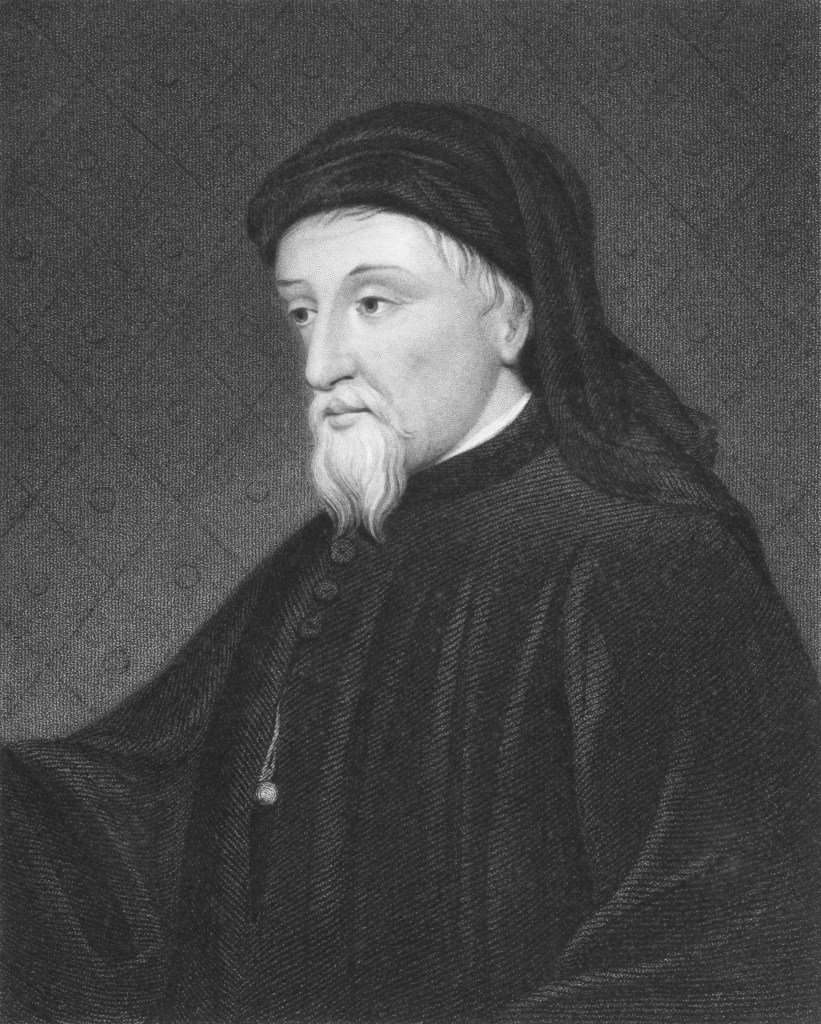
Born around 1343, Chaucer came from a good merchant family and thus made a good marriage. He worked at day jobs, as writing didn’t pay big money then either. First, as customs controller for the port of London beginning in 1374 and then as clerk of the king’s work starting in 1389, Chaucer rubbed shoulders daily with the rich and powerful.
Despite those somewhat plebian beginnings, Chaucer wrangled a position as a page in the household of the Duchess of Clarence, wife of the third son of John of Gaunt. John proved to be a staunch advocate for Chaucer throughout his life, acting both as patron and protector.
Chaucer cherished books from an early age and loved to read, retaining minute details of what he read in Latin, French, Italian, and Anglo-Norman.
Because he traveled as a diplomat for the Crown, he became familiar with Italian and French literature in the vernacular. His first poetic work—Book of the Duchesse, an elegy for John of Gaunt’s deceased wife—attests to his closeness to the King. As Chaucer climbed the ladder from page boy in an aristocratic household to luminary at Court, many significant events occurred. Taken prisoner in Reims on a mission to France during the Hundred Years’ War, Chaucer’s protector, King John himself, paid part of the ransom for Chaucer’s release.
In other words, Chaucer wasn’t a starving writer moldering in a garret someplace.
The Canterbury Tales is not a food book per se. Nor a cookbook. But it reflects the food culture of the times. There’s a definite, if not spoken, tie-in with a late fourteenth-century cookbook, The Forme of Cury. Chaucer read his work at King Richard’s court, too, so he might well have eaten food found in The Forme of Cury.
All these life experiences served Chaucer well when he filled goose quills with ink and wrote The Canterbury Tales.
Pilgrimage acted as a great social leveler in Chaucer’s day. And his cleverness in choosing that aspect of medieval English life proved to be genius.
The Canterbury Tales begins at the Tabard Inn on the south side of the River Thames. Harry Bailly owns the Inn and wagers a sumptuous dinner for thirty pilgrims, a carrot of truly magnanimous proportions in a time when food was not easy to come by. “ … a soper at oure aller cost.”
Chaucer originally planned on including 120 such tales but only finished twenty-two before he died on October 25, 1399, buried at Westminster Abbey in what became The Poets’ Corner. Plague may have taken him.
He used a literary device—framing—putting his characters together via the pilgrimage motif. Each of the thirty pilgrims is tasked with telling two tales on the way to Canterbury and two on the way back. But not all tell a story due to Chaucer’s death.
Comprised of a pretty motley mix, the pilgrims hope to arrive at the tomb/shrine of Thomas Becket. As archbishop of Canterbury, he met with a bloody demise on the altar of his cathedral. Vicious thugs hired by King Henry II murdered him. Why? Becket refused to allow Henry a role in setting ecclesiastical policies.
Chaucer’s poem, for it is that, exemplifies the roots of the heroic couplet, where the poet creates lines composed of ten syllables with “alternating accents and regular end rhymes.”
What really interests me is not poetic forms but rather the cooks.
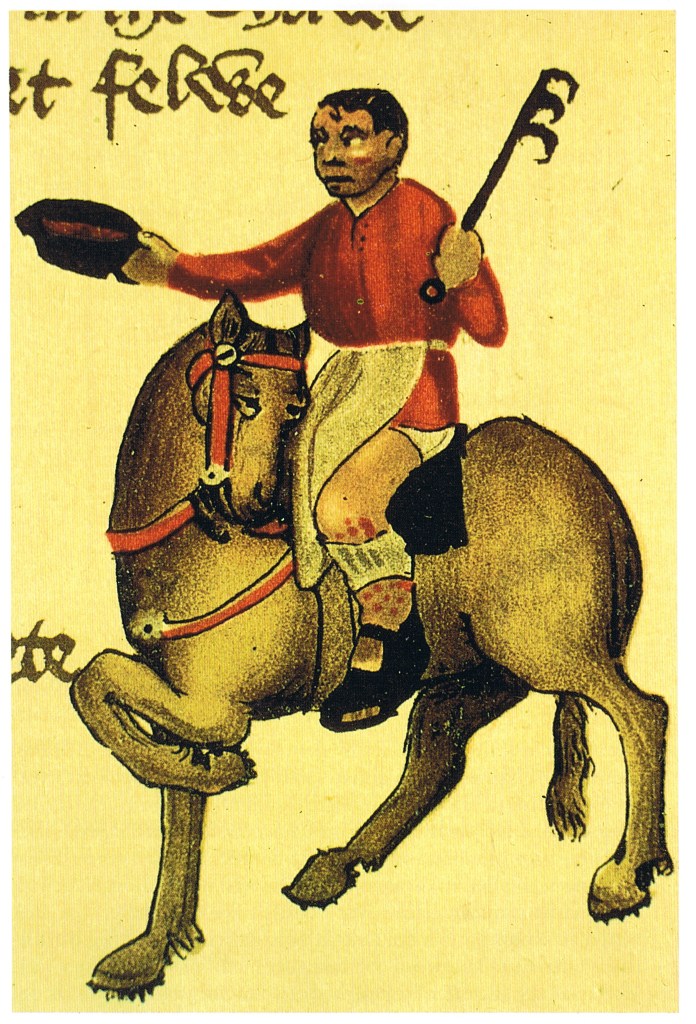
Yes, there are two, despite just “The Cook’s Tale.” Both serve bourgeois figures, especially the cook for The Franklin. The Guildsmen also enjoyed the services of their own cook, the very one telling the tale, unfinished as it is.
The Canterbury Tales testifies to Chaucer’s erudition. Mentions of gods and legends and the Crusades then bring the first mention of food: The Squire is an apt carver at The Knight’s table, though that gentleman be his father and not his true master. Food appears again with the Nun, the Prioress, who possesses exquisite manners at table, not splattering food or drink all over her vestments nor dipping her fingers too deeply into the sauce. As for The Monk, Chaucer mentions his girth and his love for a fat swan, roasted whole.
Chaucer describes other pilgrims with eagle-eyed observations of their dress and manner. He offers no food references until he arrives at The Franklin, a landowner free by birth but not noble. This particular man was “Epicurus’ very son,” loving his “morning sop of cake in wine.” Generous to a fault, The Franklin set a mighty fine table with all manner of victuals: bread, ale, wine, “bake-meat pies,” fish, meat, plump partridges, a list that made my mouth water. But then came phrases hinting that perhaps his cook ran around the steaming hot kitchen, fearing his master’s tongue if the sauce weren’t “hot and sharp.”
Allusions to humoral theory pop up from time to time, too. For example, The Summoner likes garlic, onions, and wine, which were deemed unhealthy at the time, so these likes reflect poorly on him.
And that brings to mind The Cook, a poor fellow with a nasty, suppurating ulcer on his left leg.
Chaucer’s characters all either represent real people he’s known or heard of. The stuff of stereotypes.
Bailly says of The Cook, seemingly repeating accusations common about cookshops and cooks in London at the time,
You’ve stolen gravy out of many a stew,
Many’s the Jack of Dover you have sold
That’s been twice warmed up and twice left cold;
The critical point here is the proliferation of cookshops, testifying to the popularity of takeaway food, no surprise since many people had no kitchens or couldn’t afford the fuel to cook with. But most people, if they could, grew vegetables, primarily worts and potherbs, a practice so common as to not be mentioned in the culinary literature of the day.
As an introduction to medieval English life, Chaucer’s The Canterbury Tales offers an often-humorous dissection of society, food, and religious life, all central to his world.


Yes, I am related to some Plantagenets somewhere, but the roots are so tangled, as you say.
I consider this passage (beginning, “You’ve stolen gravy out of many a stew…”) to be the first restaurant review in English.
BTW, John of Gaunt and his eulogized wife are my ancestors. On two different branches of my tangled family tree, they are both my 17th and 18th great-grandparents. Not that impressive; after so many generations, they must have thousands of their descendants…