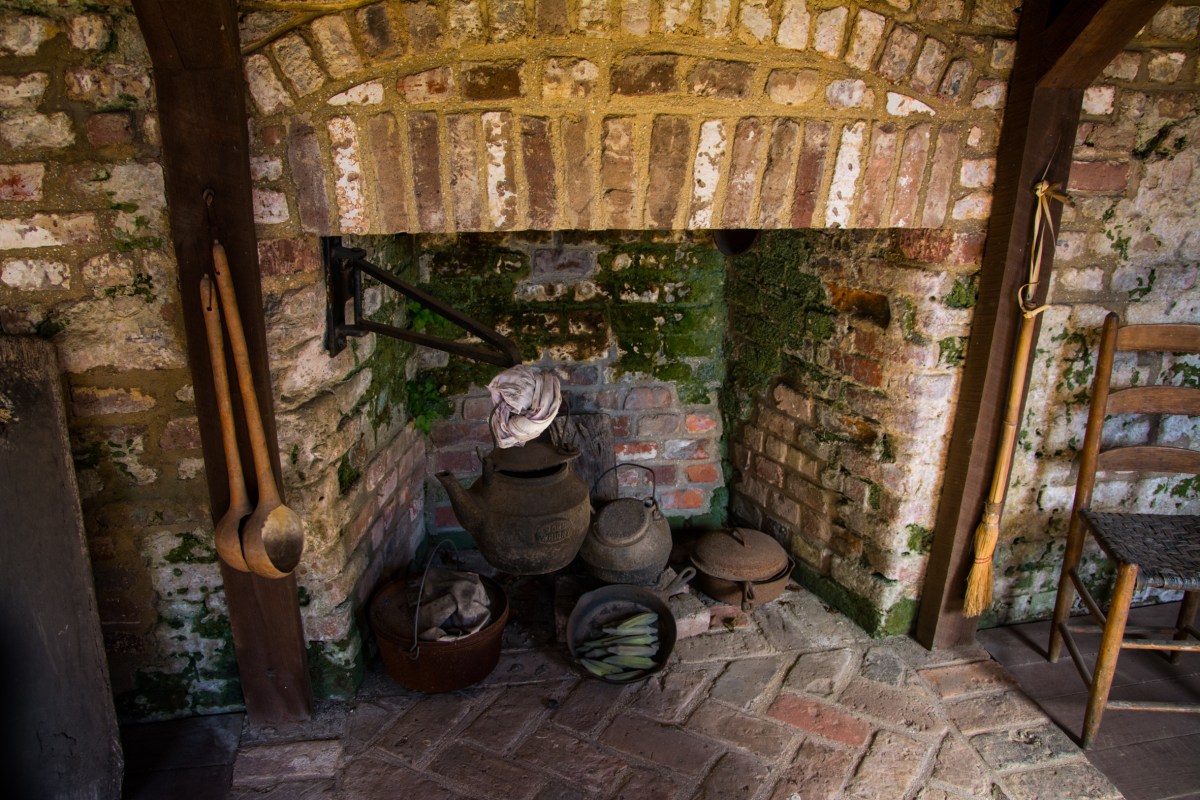

The Holy City. Oh, not the Vatican, no. I’m talking again about Charleston, South Carolina. Charleston, where rivers and sea lap gently against marshy shores, much as an angel strums a harp, quietly, calmly, making heavenly sounds. Charleston, which a resident once called a foreign city, unlike any other in America. Charleston, cradle of an antebellum aristocracy made insanely rich by rice, indigo, and trafficking in African slaves.
One such aristocrat – Sarah Rutledge, “a lady of Charleston,” and a spinster, from the sound of it, published The Carolina Housewife in 1847, eight years before her death at age 73. Her distant cousin, Anna Wells Rutledge, later wrote an Introduction to the book – essentially a culinary mini-memoir of Charleston from Ms. Rutledge’s vantage point in 1979 – and confirmed the truth about the authorship of this other “Housewife” cookbook. Apparently an “Ancient Lady” or “The Octogenarian Lady” named Mrs. Poyas let the cat out of the bag in 1855 and attributed authorship to Miss Sally Rutledge. You see, no proper lady at the time ever allowed her name to appear in print except at birth, marriage, and death. And with Sarah’s pedigree, she certainly qualified as a lady. At age 26, Miss Sally’s father Edward Rutledge signed the Declaration of Independence on a hot, sultry day in Philadelphia in 1776, under weather conditions not unlike those of his native Charleston, where oppressive humidity rules most of the time.

Now, the Rutledges counted among their family members a number of Pinckneys, another branch of the Charlestonian land-and-slave-holding aristocracy, through Harriott Pinckney Horry’s daughter marrying Frederick Rutledge and other alliances, making everyone a sort of kissing cousin in fact. The ties also included those by the marriages between Middleton sisters and Pinckneys. An interesting commentary on the strength of these ties and the impact these had on another cookbook from the same period as The Carolina Housewife appeared in 2012, wherein Donna Gabaccia and Jane Aldrich analyzed The Carolina Receipt Book or Housekeeper’s Assistant (1832).*
Anna Wells Rutledge says she “dug out” some information about Miss Sally. She spent some time in England at the age of about 10, with the family of Thomas Pinckney – a famous Charleston name and one attached to yet another Charleston-based cookbook, by Harriet Pinckney Horry, dating from 1770, published in 1984 as A Colonial Plantation Cookbook: The Receipt Book of Harriott Pinckney Horry, 1770. Harriott’s mother, Eliza Lucas Pinckney, turns out to have been a most astonishing woman, given the restrictive times in which she lived. First of all, she took her first breath in Antigua, in the West Indies and spent her childhood there. Later her father moved the family to South Carolina. When her father returned to Antigua in 1739, seventeen-year-old Eliza oversaw the management of the plantations, including her own experiments with indigo growing, becoming so successful that she shared seeds with her neighbors. She also wrote a cookbook of a sorts, digitized and available for a very hefty subscription to Rotunda, the University of Virginia Press’s digitization project of new original scholarship. The cookbook also appeared in pamphlet form as a publication of the Colonial Dames of America and can be seen scanned in its original manifestation HERE.

Twenty-six of Eliza’s recipes appear in her daughter Harriott’s cookbook and twenty-one of Harriott’s recipes in Miss Sally’s cookbook – at least three of the recipes overlap between the two latter books – 1) To Pott Beef Like Vension, 2) To Dobe a Rump of Beef, and 3) To Caveach Mackerel. A bit of the outright plagiarism, so common at the time, crops up here, because 1 and 2 came straight from Hannah Glasse’s The Art of Cooking Made Plain and Easy. And, given Eliza’s birth and early upbringing in Antigua, it should come as no surprise that she included a recipe for CocoaNut Tortes.
These women influenced their cousin Miss Sally, too, author of The Carolina Housewife, although she did not use her name on her book. Hooker suggests that Harriott and Miss Sally knew each other, because as a child Sally spent time in England with Harriott’s brother Thomas and his wife. Both Harriott and Miss Sally included instructions for preserving tomatoes; Miss Sally’s procedure “To Keep Tomatoes the Whole Year” means sun-drying!. As John Martin Taylor says, this is in the humid lowcountry and the technique of sun-drying tomatoes Italian-style is nothing new! (p. 323, Hoppin’ John’s Lowcountry Cooking)
But another influential factor looms over The Carolina Housewife: Mary Randolph. Of course, that’s obvious, because of Mary’s cookbook from 1824, right? Yes and no. In 1815, Harriott Pinckney Horry traveled north and spent some time in Richmond as a guest in Mary Randolph’s boarding house on May 28, 1815. Harriott wrote in her travel diary that she ate “excellent fare” and experienced “genteel treatment” in Mary’s boarding house, and she was lucky to be there, since Mrs. Randolph turned them away at first because she had no empty rooms. But thanks to a Mr. Otis, who gave up his room, Harriott and her party stayed in the boarding house. And she remained flabbergasted by Mary’s refrigerator, as well as her table fan for keeping flies away and off the food! She even included a drawing of said refrigerator and added that “We rode about the town with Mrs. Randolph to see the beautiful prospects with which this place abounds.”* Later in the year, she wrote on October 27, 1815 that Mrs. Randolph was sick and so she and her group ate at Major Gibbons’s residence instead, savoring “green goose, ham, tongue, cauliflower, potato, salads, peas, French beans, sturgeon, chickens, and a fine loin veal, followed by two dishes of ice cream, strawberries, pudding, preserved gooseberries, and white heart cherries.”
Eliza Lucas Pinckney’s CocoaNut Tortes
Take a Coco Nutt and dry it well before the fire, then grate it and add to it four spoonfuls of sugar powder’d, and 2 of rose Water. divide this equally and to one half put the Yolks of three Eggs well Beat and to the other half three whites.
Both Harriott Pinckney Horry and Sarah Rutledge included recipes for a similar coconut confection. Harriott’s reads thus:
Cocoa Nut Puffs
Take a Cocoa Nut and dry it well before the fire, then grate it and add to a good spoonfull of Butter, sugar to your tast, six Eggs with half the whites and 2 spoonfulls of rose water. Mix them all together and they must be well beat before they are put in the Oven.
And Miss Sally’s?
Cocoa-Nut Puffs
Two cocoa-nuts, peeled and grated, three-quarters of a pound of powdered sugar, the whites of two eggs, frothed, one table-spoonful of powdered cinnamon, one nutmeg, grated, one table-spoonful of rosewater, two tea-spoonfuls of butter ; mix the ingredients well together, and make into small cones – say about the double the size of a thimble. Put these on tin sheets and dry them thoroughly in the oven. Next day ice them, and they will be fit for use.
These three books, with their family ties and their chronology (1756, 1770, and 1847), invite a great deal more contemplation. In that time span, Britain lost its American colonies, these three families lost many members – some of whom stayed loyal to Britain during the Revolutionary War, the war of 1812 occurred, and the rising impact of the abolitionist movement began to sway public opinion about slavery in a serious way. In addition, these women traveled far more than many of the authors of other cookbooks of the time, a factor that must also be considered when forming opinions about these books.

Resources and further reading:
“Ats Jaar: A Little Taste of Southeast Asia in the Antebellum South“- a previous post on Gherkins & Tomatoes about Harriott Pinckney Horry’s A Colonial Plantation Cookbook.
Eliza Pinckney’s Receipt Book Reads Like Foreign Language to 1954 Housewives. The News Courier, April 24, 1954.
Gabaccia, Donna and Aldrich, Jane. “Recipes in Context: Solving a Small Mystery in Charleston’s Culinary History.” Food, Culture & Society 15 (2): 197 – 221, 2012.
Hess, Karen, ed. The Carolina Rice Kitchen: The African Connection (Originally published by Mrs. Samuel G. Stoney, Carolina Rice Cook Book, 1901). Columbia, SC: University of South Carolina Press, 1992.
**Horry, Harriott Pinckney, 1815 Journal, 28 May 1815, in The Papers of Eliza Lucas Pinckney and Harriott Pinckney Horry Digital Edition, ed. Constance Schulz. Charlottesville: University of Virginia Press, Rotunda, 2012. http://rotunda.upress.virginia.edu/PinckneyHorry/ELP1064 (accessed 2014-03-18).
Horry, Harriott Pinckney. A Colonial Plantation Cookbook: The Receipt Book of Harriott Pinckney Horry, 1770. Edited by Richard J. Hooker. Columbia, SC: University of South Carolina Press, 1984.
Ravenel, Harriott Horry. Eliza Lucas Pinckney. New York: Scribner’s, 1896.
Rutledge, Sarah. The Carolina Housewife. Columbia, SC: University of South Carolina Press, 1979. Also available in digital format.
Taylor, John Martin. Hoppin’ John’s Lowcountry Cooking: Recipes and Ruminations from Charleston & the Carolina Coastal Plain. New York: Bantam Books, 1992.
Williams, Frances Leigh. Plantation Patriot: A Biography of Eliza Lucas Pinckney. New York: Harcourt, Brace & World, 1967.
© 2014 C. Bertelsen
 CYNTHIA D. BERTELSEN
Thanks so much, Leo. I wish MF was still writing!
I love, love, love meeting these ladies and you have put me on the hunt for their cookery books.
Great job of scholarship, too! I can picture MF pouring delightedly over their cookbooks and loving them, too! How she loved wonderful, old cookbooks like this. Kindred hearts!
Thank you, Beth. Will be in touch soon.
Kitty, thank you, and I need to run something by you about Moroccan cookbooks.
Lovely review in Alimentum! Well done, Cynthia.
Kitty
Besides the brilliant copy the photos were fabulous. I learn so much from your writing Cindy. Thank you.