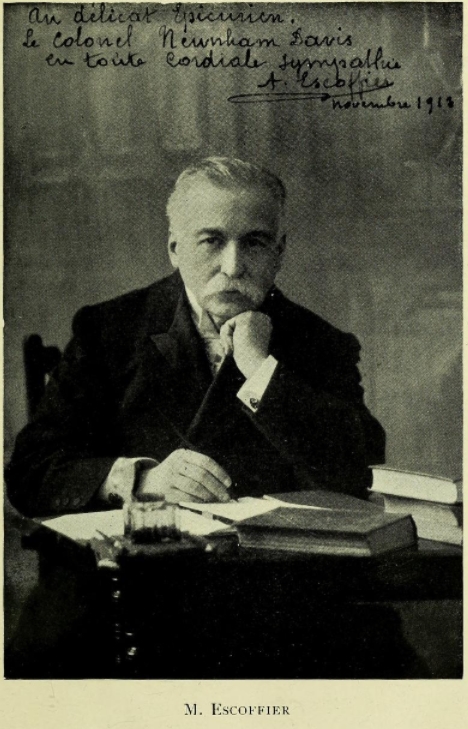
Not long ago, I read a book written by Julia Child’s great-nephew, Luke Barr. His Ritz and Escoffier: The Hotelier, the Chef, and the Rise of the Leisure Class revealed what happens when two geniuses meet.
These two men probably did more to change the way high-class hotels and restaurants operated, and the impact is still ongoing today.
Auguste Escoffier (1846-1935), with the backing and support of César Ritz (1850-1918), brought about a number of changes in French cuisine and the way food is cooked and served in restaurants. Simplifying both the cooking and serving of food in French restaurants, Escoffier turned his back on the pièces montées of famed chef Marie-Antoine Carême and introduced a new manner of service, service à la russe.
Dishes served by courses rather than presented all at once led Escoffier, who once cooked in French military circles during the fraught years of the 1870s, to utilize a military approach to organizing the restaurant kitchen. The brigade, the result of his efforts, still underlies many restaurant kitchens today, French or otherwise.
He attempted to codify French cuisine as it was at the time, publishing the first edition of his huge opus, La Guide Culinaire, in 1903. With over 5,000 recipes, it covers nearly every nuance of French cooking one could want. The last, or fourth edition, appeared in 1921.
Many of the recipes were developed during Escoffier’s time at The Savoy in London and during his relatively short stint at the Hotel Ritz in Paris.

An English translation of the fourth edition of Le Guide Culinaire is available, thanks to the work of H.L. Cracknell and R.J. Kaufman.

The following list of chefs in a full-fledged French restaurant kitchen may not always be the same in every kitchen:
- Chef de cuisine (Head Chef) – Responsible for all kitchen management. Supervises employees, creates menus, delegates purchasing of ingredients, etc.
2. Sous-chef de cuisine (Assistant chef) – Receives orders directly from the chef de cuisine for kitchen management and stands in for the chef de cuisine in his/her absence.
3. Chef de partie (Chef of a station) -Oversees a given station in the kitchen when preparing special dishes and other items.
The following are chefs de partie stations:
•Garde manger (Cold dishes chef) – Prepares cold dishes and appetizers such as hors d’oeuvres. Organizes buffets.
•Entremetier (Starter Chef) – Prepares soups, creams, and other dishes without meat or fish, including eggs and vegetable dishes.
•Legumier (Vegetable chef) – Prepares vegetable dishes.
•Potager (Potager chefs) – Prepares soups.
•Saucier (Sauce chef) – Prepares sauces and plates dishes.
•Rôtisseur (Roast chef) – Manages chefs dedicated to roasting meat or fish.
•Grillardin (Grill chef) – In charge of grilling meat or fish dishes.
•Friturier (Fry Cook) – Oversees frying and monitoring of pans for deep frying.
•Poissonnier (Fish chef) – Handles fish and seafood dishes.
4. Cuisinier (Cook) – Oversees the cooking at a station.
5. Commis (Kitchen Assistant) – Works at a partie station under a specific chef de partie.
6. Apprenti(e) (Apprentice) – Students or volunteers doing stages. Cleaning and maintaining of stations.
7. Pâtissier (Dessert chef) – Prepares desserts and other sweet foods.
8. Boulanger (Bakery chef) – Bakes bread, buns, and other products.
9. Décorateur (Restore) – Decorates and plates desserts.
10. Confiseur (Confectioner chef) – Makes candies and petits fours.
11. Glacier (ice cream maker) – Prepare ice cream and cold desserts in large restaurants, in small ones this work is done by the pâtissier.
12. Boucher (Butcher) – Cuts meat of birds, game, and sometimes fish.
13. Plongeur (Dishwasher) – Cleans dishes, cutlery, and sometimes glassware.
13. Marmiton – Cleans pots, pans, and other cookware.
14. Tournant (Relief chef) – Assists other chefs with emergency work in case of shortages of staff or supplies.
15. Aboyeur (Orders barker) – Shouts out customers’ orders.
16. Communard (Family meal chef) – Prepares the family meal for restaurant employees.t.
17. Garçon de cuisine (Kitchen Helper) – Assist chefs with simple tasks when needed.)
For more on Escoffier’s life, I recommend Kenneth James’s Escoffier: The King of Chefs:

You might also like to visit The Escoffier Museum of Culinary Art in Villeneuve-Loubet, between Nice and Cannes.
 CYNTHIA D. BERTELSEN
Thank you, Dianne. Yes, there’ve been a lot of changes, It’s too bad chefs can be so tyrannical. Kudos to your daughter for her hard work!
Dear Cynthia My daughter graduated from a prestigious culinary school in the late 90s which had a strict brigade system. She did an externship at the Hotel Savoy in London with 2 very strict chefs who yelled and swore in several languages. Toiling in the deep basement for long shifts making pastry and fixing fish dishes, she worked at a table that had to be at least 200 years old at that time. tis table had a marble top and it was always cold with the possibility of rats present in the early hours. It was an unforgettable experience which she viewed as rather Dickensian. Back to the States with a ‘harder shell’ she was hired at a fancy French restaurant and endured another tyrannical chef. I began to wonder if this was a career that would stick after so much abuse. Twenty plus years later she is a sous chef in a small, beautiful restaurant but it is still hard work. Now the brigade has been reduced due to space, lack of trained staff and frankly money concerns by owners. Brigades probably continue in exclusive hotels and cruise ships. Escoffier remains a hero with the culinary graduates who learn about his ideas, however. Thanks, Dianne