(I wrote this story several years ago. After reading Dr. James Orbinski’s gut-wrenching new book — An Imperfect Offering: Humanitarian Action for the Twenty-First Century, I’ve decided to publish this story here, on this day — Rock the Red Pump Day — when I count my blessings, giving thanks that I do not have to endure what so many women and girls must, every day of their lives. The plight of Africa’s women and girls never seems to get better — the current crises in the Congo and Zimbabwe attest to that sad fact. See The Washington Post’s article on women and childbirth in Sierra Leone. And The New York Times’s article on rape in the Congo almost stopped my heart. I dedicate this article to Celestine and all her sisters. For they are all my sisters, too.)

Blending as they do into the green leaves of the red-flowering flamboyant trees above the crumbling mud brick wall, it’s hard to see the bottle-green chameleons. Dozens of these “ground lions” perch in the crevices of the wall, their red throats puffing in and out like bellows stoking a fire.
I envy the chameleons more each day—their food comes to them, snatched up quickly with their long projectile tongues. They just sit and they wait, scanning their world with their beady black eyes sleepily opening and closing like two tiny ball and socket joints.

I envy the chameleons, yes, I do.
For me, getting food is a daily running of the gauntlet. So many desperately poor street vendors out there. All women, all grabbing at me, pawing at me, shrieking at me, “Buy my vegetables, Madame! Madame! S’il vous plaît!” I want to avoid the streets. I want home delivery of vegetables. I do want to be like a chameleon. I want my food to come to me. I want to blend in.
I don’t remember exactly how she started coming to me, this African Muslim woman riding astride her rusty blue moped, her serpentine tie-dyed green gowns flowing like bridal trains behind her, always green, clean, starched, and prim. Sparse, wiry black hair peeks out from underneath her enormous and flamboyant matching green turban. A big straw basket, its fraying edges like tendrils of a young bean plant, rides behind her on the moped, strapped down with worn rope.
I never learn her real name, so in my mind I call her Celestine. She never calls me anything but “Madame,” and I call her “Madame,” too. Just two women, from opposite sides of the earth.
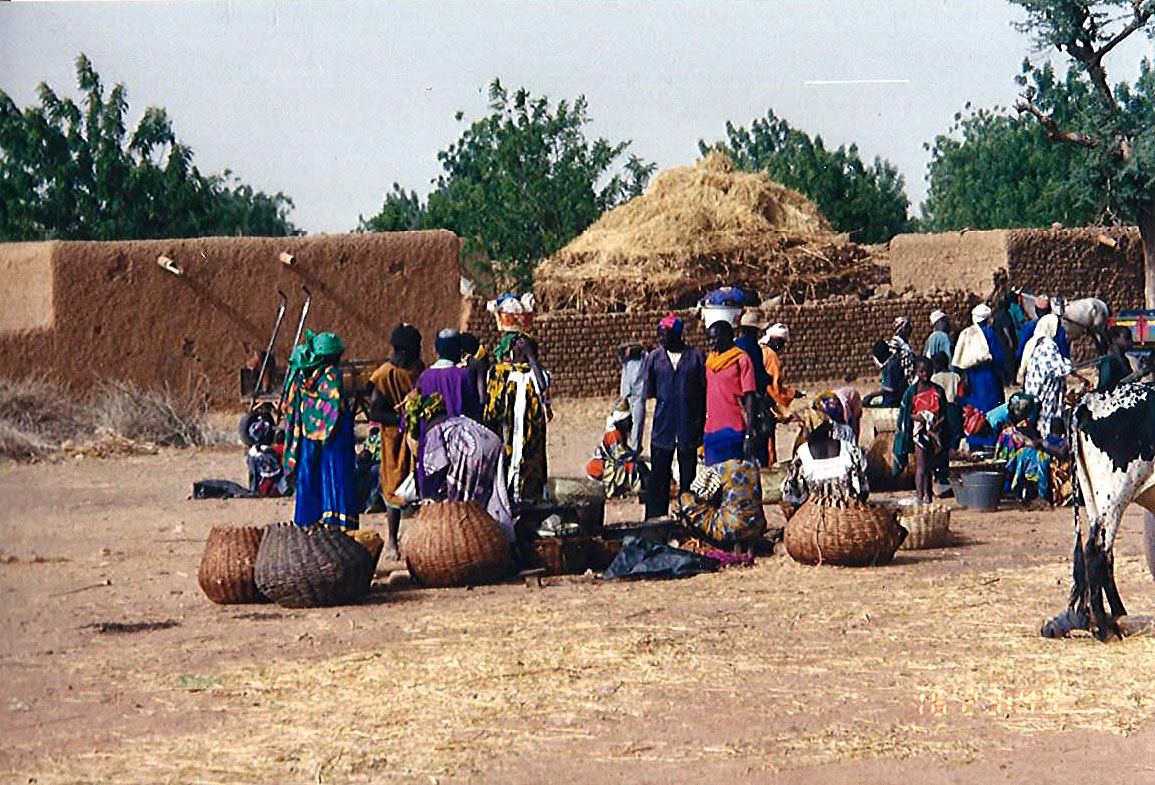
Placing the heavy basket on her head, Celestine gracefully walks through the iron gate toward my front verandah, sashaying like an anorexic ballet dancer performing a chassé. Vegetables poke out of the top of her basket, like so many baby birds peering cautiously from their nest. Scrawny limp carrots, mushy tomatoes, wilted cabbages, yams with shriveled brown skin, small red peppers so hot a touch scalds fingers, tiny juicy oranges, and now and then a soft mango or a bruised pineapple carpeted with flies sucking out the sweetness. Never is there much more than that, until the rains come, that is. And then only a few scraggly parsley sprigs, maybe slices of a pumpkin-like squash, and always some mysterious green leaves the size of an elephant’s ear, rolled up like posters and tied carefully with burlap string saved from a coffee bean bag.

Dropping her basket on the top step of my tiled porch, Celestine’s thin cold hands extend first toward me in greeting, always after a polite delicate cough, a hint of embarrassment, and gratitude for the glass of iced water I present to her in our private version of a Japanese tea service. I take the glass from her and push my empty market bag forward, its floppy straw craw ready to receive food, from this woman whose dark eyes I can only meet by craning my neck as if to see a spider web at the top of a doorframe.
Squatting down in that graceful way no Westerner can ever easily imitate, heels flat on the ground, and taking each vegetable from her basket, like a cat moving her kittens from one home to another, Celestine carefully places each one in my basket, apologizing for the bump on this one, the bruise on that one. Soon the mound of vegetables reaches the “it’s-time-to-talk-price” level.
“Combien? How much?,“ I ask.
She sighs, straightens up, her gaunt face shiny with beads of sweat from the effort, her sparkly fevered eyes blinking away a fly.
“For you, Madame, the price is … .”
Waving my hand impatiently, I smile, saying nothing. I know the price is too high. But this slim woman whose cheeks resemble chiseled ebony more and more every week, whose discreet cough sounds deeper and wetter every time I see her, needs the money. I sense her unspoken need. The bargaining game I won’t play with her.
 I dig through my money envelope and hand her the colorful paper money and a few coins, placing it all in her skeletal hand, wondering if I will see her next week as I say “À la prochaine.” Until the next time.
The weeks pass as the long dry season extends into July, nearly starving even us, the foreigners. Only US commissary food sits in my cupboards, cans and bags and boxes stamped ominously with expiration dates from before last year’s Christmas. No matter. Food is food. We eat. And we dream of our grandparents’ gardens, of our mothers’ kitchens, of holiday tables laden with food.
We are the lucky ones. At least we have something to eat. The local people are not as fortunate.
But still Celestine comes every week with a few token vegetables. Each week she diminishes a little more, her walk less a dance than a trudging. Seeing her fading away in front of my face reminds me of watching films of the liberation of concentration camps. Each time she appears at the gate, those images haunt me, creating mental snapshots of emaciated, walking skeletons.
Finally, one week Celestine doesn’t come. Another week passes and she still doesn’t come.
I start finding mummified chameleons on the mud brick wall, their little bones piercing through thin dried green skin. I begin to think that being a chameleon is not all that great after all.

I go back out on the streets again, running the gauntlet of pawing, frantic vegetable vendors. I ask them about Celestine. Their dark eyes look away when they speak. No one knows anything. But from their silence, I sense that AIDS has brushed me, albeit lightly, with its insidious terror.
Every time I read that increasing numbers of AIDS victims are women, I see Celestine. Tall. Dignified. Strong. Brave. Performing small acts of hope to go on living by selling vegetables to a foreigner. Dead.
Shamefully, I recall washing my hands over and over again, careful not to touch myself anywhere until I washed my hands almost raw, careful to sterilize Celestine’s water glass every week. Careful not to get too involved.
Mea culpa.
© 2011 C. Bertelsen

 CYNTHIA D. BERTELSEN
And thank you, Sue, for stopping by and sharing your reaction.
So moving – thank you!