Last Days of an Iconic French Cultural Figure
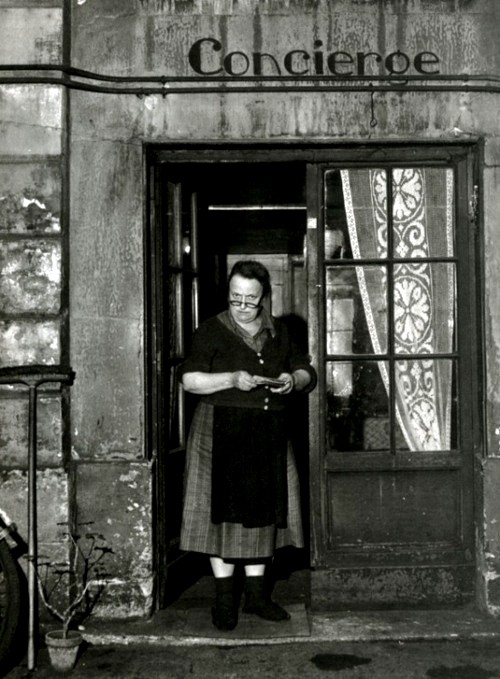
This photo hangs on a wall in my kitchen. It sums up the stereotypical essence of traditional concierges of the past.
I stayed once in a garret in Paris on the Île Saint-Louis for a month. Unlike the woman in Robert Doisneau’s iconic photo, the building’s concierge mostly hid in her loge, so I rarely saw her. The main door opened with a code, so she no longer had to pull a cord to open the door for the tenants day and night. She never gave me “the look.”
Being a concierge often was not considered to be a respectable job. The French coined a few derogatory terms for them: “las bignoles” being one. Concierges gained a bad reputation from Marie-Joseph “Eugène” Sue’s serial novel of 1843, “The Mysteries of Paris.” Other slang for concierges include the words “pipelet” and “pipelettes,” after the surname of the intrusive concierge couple in the novel, the Pipelets.

Concierges generally were women in Paris (and other big cities in France) who associated themselves with larger apartment buildings owned by a third party. These wealthy people hired the women – and sometimes men – to sort the mail, put out the garbage, check on people’s comings and goings, clean the stairways, and maintain the courtyard. Their living quarters came free, with a low monthly stipend. The living quarters, called loges, generally consisted of a few rooms, but that arrangement could be different, depending on the building.
The life of a concierge could be very hard, full of endless, unappreciated, and thankless work.
Numerous residents treated their concierges very poorly. They complained of foul-smelling food odors roiling from the poor kitchens of the concierges. Tenants also resented the nosiness and the surly attitudes of many concierges. The truth is, the concierge could keep track of people’s comings and goings, what mail they received, and multiple other aspects of their tenants’ lives. During World War II, the Nazis took advantage of this as countless concierges informed on people. And, of course, many did not, such as Louise Pétron, a concierge in the 17th Arrondissement during the German occupation of Paris from 1940 to 1944.
In recent years, the number of such concierges in France has declined. As long ago as 1993, The Los Angeles Times reported that there were 20,000 traditional concierges, as opposed to 60,000 in 1965. In 2004, The Guardian revealed that each year, 2,000 concierge jobs are disappearing. As for the situation now, who knows?
Modern technology put them out of business when building owners started installing code boxes outside the main doors of the buildings. Along with codes, which eliminated the need for bells on cords to alert the concierge to open to main door, building owners hired third parties to clean common areas, maintain courtyards, and dispose of the garbage, etc.
Social reformers such as the Syndicat National Indépendant des Gardiens d’Immeubles, Concierges et Professions Connexes began advocating for them because retired concierges had few places to go once they left their loges.
My cousin’s concierge in her apartment building on the Rue de la Bûcherie was Portuguese. Apparently, he – yes, he – helped her with all sorts of unusual requests, including assisting her with finding an English-speaking French lawyer to handle her inheritance under French law. When her husband died and left the apartment to her, she panicked because she spoke very little French. She left the concierge a sizeable amount of money in her will, knowing that he and his family might soon be left without much after twenty-five years of labor.
The loss of this traditional role in French society speaks to artists and writers.
Take photographer Robert Doisneau, who created an engrossing photo essay about traditional French concierges.
And author Muriel Barbery wrote The Elegance of the Hedgehog, a novel about Renée Michel, a concierge who was anything but traditional. It sold 346,000 copies in the first year of its release. After adapting the novel to film, the author sold over 6 million copies.

Literature by concierges, in their own words, exists only in short articles, rarely in books.
Thus, I eagerly await Confessions of a Concierge: Madame Lucie’s History of Twentieth-Century France by Bonnie G. Smith.

There’s more to traditional concierges than brooms, mops, and buckets of water, that’s for sure.
 CYNTHIA D. BERTELSEN
Yes, unfortunately. Many aprtment buildings now contract out the duties formerly handled by concierges.
The story of concierge is very pathetic and sad to know. Back to many years ago, the necessity to make use of these people in various activities were high i think. Nowadays, as the world evolves, the necessity has become less.
You educated me. I have always associated a super with an apartment building and a concierge with a hotel.