Central Africa (Angola, Democratic Republic of the Congo, Gabon, Republic of the Congo, Central African Republic, Equatorial Guinea, Malawi, Rwanda, Burundi, Cameroon, Sao Tomé & Principe)**
The Portuguese, French, and Belgians left their mark on the region in many ways, including aspects of their cuisines. But foreign travelers, settlers, and novelists like Joseph Conrad christened Central Africa the “heart of darkness.” This forest-rich, water-blessed region is home to hunter-gatherer groups (formerly called Pygmies), whose food perhaps forms the basis for the idea of African foods being inaccessible and beyond exotic: wild game (bushmeat) and berries, insects, snails, leaves, mushrooms, nuts, honey, and roots.[1]
Even the hunter-gatherers have adopted some of the foods of the more settled agriculturalists, foods which frankly can be found in just about any reasonably well-stocked American supermarket:
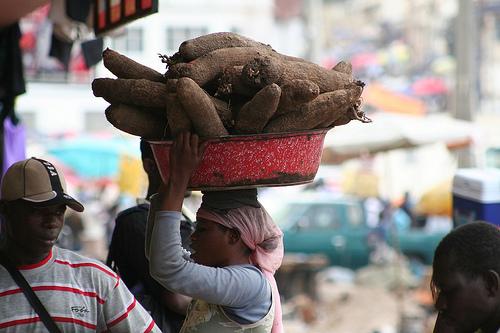
Starches: Cassava, sweet potatoes, mealie meal/pap and samp or dried corn kernels, bananas, plantains, rice yams
Thickeners: Okra, melon and squash seeds (egusi), peanuts
Vegetables: Pumpkin and other squashes, green leaves, onions, tomatoes, peppers
Oils: Palm oil, Peanut oil
Meat and fish: Meat, fresh and salted fish, dried fish and shrimp, poultry like chicken and guinea fowl, goat
Spicing: Salt
Some of the foods not readily at hand in American supermarkets include cocoyam (taro), bitter leaf, sorrel, and the fat thumb-thick larvae of the African palm weevil (Rhychophorus phoenicis).
Another flavor element that predominates in this region is bitterness, as exemplified by ndolé, green leaves characterized by their bitter taste. And sourness, in the form of lemon juice, sometimes enters the pot.
Four ingredients – tomatoes, onions, peppers, and peanuts – form a quartet of flavorings that underlie the many stew-like dishes in the region, especially tomatoes, onions, and peppers. Cooks serve these stews with the staple cornmeal mush, called nshima in Zambia or fuba in Angola.
Fermented grains, like the cornmeal sourdough called poto-poto (an echo word as described by Osseo-Asare, stemming form Bantu usage and including such words as fufu and sakasaka), add another flavor layer to the meal patterns of the region.
[1] Fran Osseo-Asare, Food Culture in Sub-Saharan Africa, Santa Barbara, Calif.: Greenwood Press, 2005, p. 137.
**For the next few weeks, I am going to be on a “working vacation,” so my posts will be somewhat more abbreviated. I will still provide you with something substantial to chew on, though!
© 2009 C. Bertelsen
 CYNTHIA D. BERTELSEN
Thanks for writing. You’re right, I suspect that you will not be able to substitute anything other than the greens you mention, but you could try Asian groceries for other possibilities.
Hello there! You have a lot in common with my father’s new blog: http://pilipilisakasakadiaries.wordpress.com/ and you both have a red/green combination for your title! I loved your post on Central Africa, and it made me hungry for the foods I grew up on, but I am not sure if I can replace the main leaves of sakasaka with anything in the US…They’re the green leaves of the Manioc (or Cassava) plant, and are not as tender as spinach, nor as tough as kale. What do you think I could replace them with? In Congo, they pound these leaves up to a pulp, then cook it up with onions, green onions, smoked fish and palm oil (some versions bring in peanut butter) for a meal that is the most delicious I’ve ever eaten in my life. Now I’m seriously craving it, but have no idea how to replace the greens…
Thank you! I’m getting to like the new format more and more myself.
Just to say I like the new format. Nice blog altogether in fact!