On February 6, 1986, the Haitian people woke up to a new world — their long-simmering protest against the Duvalier dictatorship succeeded. Duvalier flew out of the country, with the help of the United States, to France, where he still lives in exile.* And in Haiti daily existence morphed into something new for everyone as the long-sought change in power occurred, at least emotionally. Unfortunately for Haiti, in the end, nothing really altered the centuries-old social and political patterns. Haiti continues to suffer periodic civil unrest.
Shopping for food, no matter where in the world, usually proves to be a joyful task. There’s something about food that brings people together and fosters a sense of identity. Some people go to museums when they travel – I frequent street markets. Poking the tomatoes, prodding the chile peppers, breaking off a hunk of fragrant golden ginger, and deliberately bruising cilantro leaves to get a whiff of that perfume, nothing save food shopping (or buying perfume) can be beat for odoriferous experiences. And shopping for food in a Third World country offers perhaps the most intense immersion in all things olfactory. Rotting vegetation, open sewers, burning charcoal, pungent-smelling dried shrimp with sightless beady black eyes, smoked fish chasing their own tails, the list of “smellable” experiences grows and grows.
In Haiti, especially, food shopping could be particularly odoriferous and odious, too. In fact, with the continuing social unrest that pops up from time to time, Haiti hardly seems the place where shopping of any sort could be a consuming joy.
But it could be, in a way.
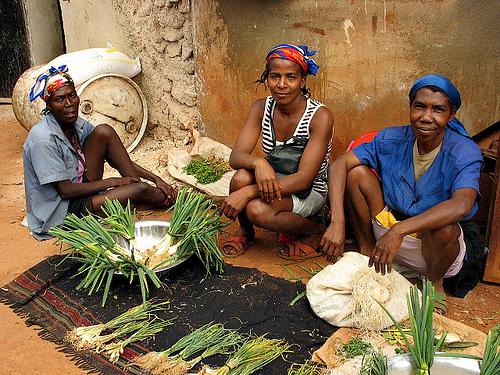
True, huge piles of putrefying garbage shared space beside Petionville’s grand Cathedral Square with the market ladies, “Madame Sarahs,” as they were called for some mysterious reason. Flies crawled thickly over decomposing pineapples, and yellow skeletal dogs fought each other ruthlessly for the odd bony tidbit. Each “Madame Sarah” laid out her wares in small, symmetrical piles, atop a torn square of filthy cloth, so dirty that the original color was hard to determine. Color ruled elsewhere, however, in the brightly colored headscarves worn by each “Madame Sarah,” in the symmetrically arranged tropical fruits and tomatoes and leafy greens and cut flowers, and especially in the bougainvillea and flamboyant trees growing amid the cracked asphalt. One built up a relationship with individual market women, while not friendship, it certainly imbued a sense of something deeper than a mere business deal. The best thing to do was to shop always with the same “Madame Sarahs.”
Petionville, my last stop, glimmered on that gloriously sunny day, blue sky above, a soft warm breeze rustling the leaves of the skinny trees nearby. With no demonstrations or new curfews announced by the U.S. Embassy, I could feel my neck muscles relaxing as I swung my beige Isuzu Trooper into a parking space across from the cathedral where the dictator Baby Doc Duvalier married Michele “Dragon Lady” Bennett amid wall-to-wall gardenias. One more errand and I could go home.
Returning from a hoarding trip to the Embassy commissary, I just needed to pick up a few vegetables, chiefly carrots and some lettuce. Stuff that could feed an average Haitian family of 10 for a month jammed packed the back of my Trooper. As I climbed down out of the Trooper, about 20 “Madame Sarahs” besieged me, shouting in Creole to buy this papaya or that leek. This was not my usual market, for that one closed at around 1 p.m. My watch showed 2:30 p.m.
I walked over to the nearest “Madame Sarah” selling carrots and asked her in my best Creole how much she wanted for them. By this time, quite a crowd had collected around me. Imagine the scene: me, the “rich” foreigner driving a four-wheel drive vehicle, ready to buy something from somebody. It was like a lottery — who would “win” my money that day? Warm bodies began pressing on me, craning over my should to see what I bought, how much I paid for it, maybe even glimpsing how much money lingered in my wallet and could perhaps be wheedled out of me. As the bodies pressed closer, I smelled charcoal and human sweat, warm sour breath and hair pomade.
And I also sniffed my own fear as I suddenly realized that I was the only foreigner there, and although Duvalier’s thuggish Tonton Macoutes no longer ruled the streets, it was a period of violent civil unrest. And a crowd of determined and increasingly belligerent market women surrounded me.
I paid for the carrots, smiling broadly at everyone as I turned and tried for a fast get-away. Alas, I wasn’t fast enough.
As I turned toward the Trooper parked about 5 yards away, a tall woman who could double for football player William “The Refrigerator” Perry approached me with two pineapples that clearly should have been sold two or even three days before. The dark fermenting spots around the “eyes” told me that.
“Madame, 8 gourdes for these pineapples! Madame!” [1 U.S. dollar = 40 Haitian gourdes in January 2009]
I tried to put her off by saying “Merci, I don’t need any pineapples today. Maybe tomorrow. Merci,” as I flung open the back of the Trooper to throw in the carrots and get the hell out of there. Big mistake.
Once the pineapple woman saw what was in the back of my truck, envy and resentment and anger surely overtook her reason. She parked herself between my door and me. I could not shut the back door and escape. Crowds of onlookers pressed me from behind and this enraged woman stood solidly in front of me. Yes, I should have bought the pineapples and have done with it. But I didn’t.
Thinking fast, asking myself in a very detached way, “What am I going to say here before they hit me, or worse?,” I spoke in my fractured Creole, sounding like a child learning to talk, but nonetheless getting my point across.
“Listen, I will come back tomorrow and buy something from you then. I promise. Just now I need to get home and cook for my son.”
With the mention of my son, she screamed that she had a baby and had to buy milk for him and for her so that she could nurse him, too. She needed to sell something so she could buy the milk. And then she did something that stunned me, and probably all the onlookers: she pulled down her white spaghetti strapped tank top over her bulging breasts, grabbing her right breast with both hands, and squirted breast milk all over the food in the back of my Trooper.
Trembling to my core like a frightened kitten, in my smallness I had the presence of mind to stay calm. I placed my hand on her shoulder, and looked her square in the eyes and said, “I WILL be back tomorrow, but please let me go now.” With that I subtly maneuvered her away from the back door of the Trooper, slammed the door, my key at the ready, walking determinedly with my hand still on her shoulder and assuring her of my sincerity. With shaking knees, I clambered into the car, smiled one more time at the crowd, and took off like a shot, cold sweat rolling down my sides in trickles.
I went back the next day, sought out the breast-milk lady, and from her I bought the lettuce I had forgotten the day before, plus more. I bought devil-red tomatoes, misshapened carrots, juicy yellowish-red mangoes, tiny French haricot beans, plump purple eggplants, hot bonnet peppers, and other things from her many more times before street violence overtook civil law and we fled Haiti, back to America. Because we could.
Just as Proust recalled whole memories with bites of madeleines, for me it was the smell of sour milk that stubbornly clung to the Trooper, calling up flashing images of that day for quite some time to come.
But the most enduring memento of that moment lay with the realization that no matter how long I stayed in developing countries, no matter that I’d lived in a shack in Paraguay as a Peace Corps volunteer, no matter that I worked as a nutritionist in humanitarian aid, I still would never, ever really know what life is like for most of the world’s people.
Intellectually, yes, or just maybe.
Viscerally, no. Never.
Otherwise, I would have bought the pineapples gladly, wouldn’t I have?
[For a glimpse of life in Haiti, take a look at Jan Sochor’s slideshow on Haiti. He offers a lot of visual insights into the current food situation in Haiti. ]
*But not the high life one would think — Duvalier’s Parisian pied à terre consists of a one-bedroom apartment. He lost his fortune during his divorce from Michele.
 CYNTHIA D. BERTELSEN
Yes, defiance sums it all up.
My god, what a gesture- the woman, the groceries, your car. I won’t forget that image for a long time if ever.
The ultimate gesture of defiance.
………………………………
Yes, we are spoiled.
Yes, it is. I’m reading some material written by Elizabeth Robins Pennell, whose cookbook collection along with the Bitting collection, forms the core of the Library of Congress’s rare cookbook collection. She talks about the café life of the Gilded Age in Europe and mentions that people congregated there because their rooms were always cold. Imagine that, perhaps in some way great art and literature owes some of its geniuses due to the bitter cold?
I recall that as a child I lived in a house for a few years with an oil-burning stove in the center of the house, until my father put in electric heat. Always, always ice coated the insides of the window of my bedroom in the winter mornings (Washington state). My husband grew up on a Wisconsin dairy farm and they never enjoyed heating except for the wood-burning stove in the kitchen. Everyone dressed by the stove in the mornings.
My goodness Cindy. That was quite a day. And about the viscerally, I was just thinking the other day that we now have two or three generations of Americans (and Europeans too probably) who have never been cold. Oh perhaps chilly after skiing or when there was a power outage. But systematically cold, all winter, every winter. That’s something different.