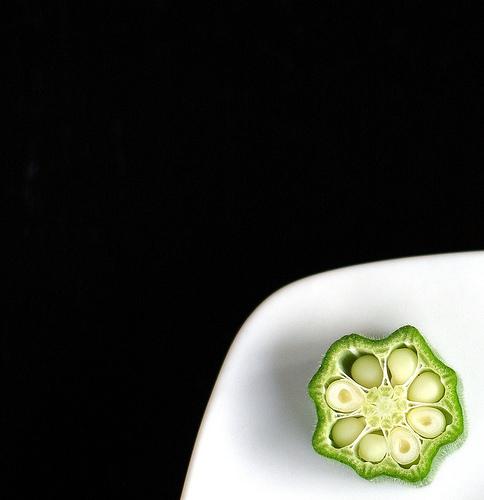
Okra (Abelmoschus esculentus, previously Hibiscus esculentus), that beveled beauty so beloved by Arab, Indian, Southern American, and West African cooks for its mucilaginous nature, originated in Ethiopia.
From the Niger-Congo language family, the term “okra” derives from a Twi word, nkuruma, according to the Oxford English Dictionary (OED). By the early 1800s, English speakers called it “okra.” Other names include Lady’s Fingers, gombo, gumbo, quingombo, okro, ochro, bamia, bamie, and quiabo. The “gumbo” connection appears to stem from Bantu, “kingombo,” which explains the Romance language propensity for related words. For example, Spanish speakers say quibombo, qimbombó, or quingombó, while French speakers trill gombo, bamia or bamya. Further afield, in India, one word for okra is bhindi, while in the Middle East, bamies signifies “okra.” Other words include chaucha turca, from Argentina; chinbombó, from Venezuela; and on it goes.
Early Arab writers indicated that okra flourished in Egypt as early as 1216, while later, in Virginia, Thomas Jefferson grew okra on his farms near Monticello by 1781; Karen Hess states that she found no writing where Jefferson mentioned okra until 1809. The first published recipe using okra in an American cookbook appeared in Thomas Cooper’s 1821 Domestic Encyclopedia, and, in The Virginia Housewife (1824), Mary Randolph followed suit with her recipes for “Ocra and Tomatoes” and “Ochra Soup,” the latter a recipe very similar to many gumbo recipes, minus the fiery hot peppers, so commonly used nowadays.
To the uninitiated, okra leaves resemble marijuana plants, as the follow story relayed by Heather Tutorow so aptly illustrates:
My grandparents are transplanted Oakies. They moved to Modesto, CA in 1950. My grandpa, as long as I can remember, has had at least an acre of okra. Right after they moved to Modesto, my grandfather woke up one morning to find several Sheriff’s officers tromping through the okra and stepping on the watermelon. He went out to see what was up. The Sheriff was convinced that my grandpa was growing pot in his garden and had never heard of, let alone seen, okra. It took a couple cups of coffee and a few of last year’s pickled okras to send this law officer on his way. He later became a close friend of the family. Much like everyone who has ever crossed paths with Grandpa. It just isn’t summer without okra.

But let’s not forget where okra came from – East Africa. That’s right. Enjoy this African version of gumbo.
West African Fish Gumbo with Okra and Spinach Leaves
Serves 6
½ cup palm oil (dende)
1 medium yellow onion, finely chopped
4 button mushrooms, chopped
1 habanero pepper, seeded, and finely chopped
1 T. fresh ginger, peeled and minced
4 cloves garlic, peeled and finely minced
½ lb. fresh tomatoes, chopped
1 lb. fresh or frozen okra, cut into ¼-inch slices
Sea salt and freshly ground black pepper to taste
½ lb. fresh spinach, washed, drained, and chopped
6 scallions, thinly sliced
¼ cup tomato paste
1 ½ lbs. cod fillets, cut into bite-size chunks
Flat-leaf parsley, chopped, for garnish
Cook the onion in the palm oil over medium heat until translucent. Add the mushrooms and cook until mushrooms are lightly browned, taking care not to burn the onion. Toss in habanero pepper and ginger, cook a few more minutes. Add the garlic, cook 30 seconds more, then add the tomatoes and cook until slightly soupy. Stir in the okra, salt, pepper, and ½ cup water. Cover pot. Reduce heat to low simmer. Cook until okra is done and stew looks soupy.
Add remaining ingredients, stirring only once to mix in. Let simmer until fish is fork-tender. Pour into serving bowl. Sprinkle with parsley. Serve immediately with white rice.
© 2008 C. Bertelsen
 CYNTHIA D. BERTELSEN