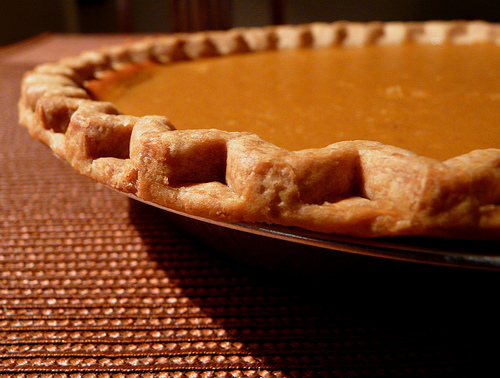
Just in time for Halloween, the frost descended on the pumpkin weeks ago. It shows no sign of retreating yet. And now Thanksgiving is nearly here …
With a stroke of his pen, in 1863, a time when the United States didn’t see a lot to be thankful for as the Civil War skimmed off the lives of young men, President Abraham Lincoln officially created this national holiday. A day for giving thanks for the bounty of our days. It all came about because of the insistence of Sarah Josepha Hale, editor of the wildly popular Godey’s Lady’s Book and a cookbook author, too. A Pilgrims-in-Plymouth myth arose, complete with seemingly “set-in-concrete” menus.
As I grabbed a couple of cans of that old standby out of my kitchen cupboard — Libby’s 100% Pure Pumpkin, I questioned the whole mythic role of pumpkin in America food lore. Why pumpkin? Why pumpkin pie? Did people in the White House eat this national dish or not before Lincoln? (Few people in the White House seem to have recorded pumpkin pie recipes, although it appeared on official menus occasionally. Lincoln did eat it, according to contemporary accounts.)
And I wondered also why authorities say that the word “pumpkin” comes from an variation of pompion or “melon ” (1545), which in turns stems from a medieval French word pompon, in turn from the Latin word for “melon,” peponem. The Greeks had a word for it, too: pepon or “melon,” which speculatively originally meant “cooked by the sun, ripe,” from peptein, “to cook.” Maybe.
Since pumpkins and their cousins in the Curcubita moschata family formed a fourth part of the Holy Trinity of the Amerindian diet — corn, beans, chiles, and supposedly originated in the Americas, the claim that pumpkin-like vegetables existed in Europe or elsewhere in the world earlier than 1492 seems a bit questionable, although Asia boasted several gourd-like specimens. In Mexico archaeologists discovered pumpkin-like seeds dating to pumpkin-related seeds dating to between 7000 and 5500 B.C.
The Massachusetts Pilgrims and, earlier than that, the Jamestown blue bloods learned about squash and pumpkin from the Native Americans. Because pumpkins looked a little bit like food the colonialists knew from England and Europe, pumpkin sneaked into the American larder a little faster than did other New World foods, namely tomatoes and potatoes.
Pumpkin, as pie, first appeared in English-language cooking literature in 1653 as a distinct recipe. Remember — Jamestown, Virginia, 1607. First permanent English settlement in the New World. As a transplanted Virginian, I like that. Pilgrims, Plymouth, Massachusetts, 1620. Granted, few Englishwomen showed up in Jamestown, so pumpkins probably avoided the crusts early on.
And it’s pumpkin pie I want to dissect. How did we get from then to now?
Francois Pierre la Varenne wrote up a recipe for pumpkin pie in his Le Vrai Cuisinier François (The True French Cook). It was translated and published in England as The French Cook in 1653:
Tourte of pumpkin – Boile it with good milk, pass it through a straining pan very thick, and mix it with sugar, butter, a little salt and if you will, a few stamped almonds; let all be very thin. Put it in your sheet of paste; bake it. After it is baked, besprinkle it with sugar and serve.

Other English cookbooks contained “pumpion” recipes and these cookbooks — specifically those by Hannah Glasse (The Art of Cookery Made Plain and Easy, 1747) and Eliza Smith (The Compleat Housewife, 1727) greatly influenced the housewives and cooks in colonial America. Not until 1796, however, did the new United States see a cookbook that was uniquely American in its focus. With the publication of Amelia Simmons’s cookbook, American Cookery, pumpkin pie took its place in the grand pantheon of American cooking:
Pompkin Pudding No. 1. One quart stewed and strained, 3 pints cream, 9 beaten eggs, sugar, mace, nutmeg and ginger, laid into paste No. 7 or 3, and with a dough spur, cross and chequer it, and baked in dishes three quarters of an hour.
Pompkin Pudding No. 2. One quart of milk, 1 pint pompkin, 4 eggs, molasses, allspice and ginger in a crust, bake 1 hour
Notice a little linguistic confusion there? Pudding?
Or custard?
Pumpkin pie, according to modern definitions, is a form of custard. Food science guru, Harold McGee, defines custard as meaning “a dish prepared and served in the same container, often baked and therefore unstirred, so that it sets into a solid gel.” McGee uses the word “creams” for what are popularly called “puddings,” or mixtures that use many of the same mixtures as custards but stirred on top of the stove. Puddings, a very English menu item, fed people well when food remained scarce. The Norwegian concoction, romergrøt, comes to mind here, although puddings as the English understood them tended to be haggis-like in nature. Alan Davidson, in The Oxford Companion to Food, suggested that pudding derived from the Latin word botellus, meaning sausage. That’s not too far off from the French “boudin” and then “pudding.”
But I digress. It’s pumpkin pie I want. And since the White House either reflects, or sets, culinary trends (I’m still puzzling over that one), including pumpkin pie recipes from a variety of White House-related sources seemed like an interesting idea for this pre-Thanksgiving meditation.
First up are recipes from the frankly misleadingly titiled The White House Cook Book (1887) by Mrs. F. L. Gillette and Hugo Ziemann, former White House steward under Grover Cleveland:
STEWED PUMPKIN OR SQUASH FOR PIES.

Deep-colored pumpkins are generally the best. Cut a pumpkin or squash
in half, take out the seeds, then cut it up in thick slices, pare the
outside and cut again in small pieces. Put it into a large pot or
saucepan with a very little water; let it cook slowly until tender.
Now set the pot on the back of the stove, where it will not burn, and
cook slowly, stirring often until the moisture is dried out and the
pumpkin looks dark and red. It requires cooking a long time, at least
half a day, to have it dry and rich. When cool press through a
colander.

BAKED PUMPKIN OR SQUASH FOR PIES.

Cut up in several pieces, do not pare it; place them on baking tins
and set them in the oven; bake slowly until soft, then take them out,
scrape all the pumpkin from the shell, rub it through a colander. It
will be fine and light and free from lumps.

PUMPKIN PIE. No. 1.

For three pies: One quart of milk, three cupfuls of boiled and
strained pumpkin, one and one-half cupfuls of sugar, one-half cupful
of molasses, the yolks and whites of four eggs beaten separately, a
little salt, one tablespoonful each of ginger and cinnamon. Beat all
together and bake with an under crust.

Boston marrow or Hubbard squash may be substituted for pumpkin and are
much preferred by many, as possessing a less strong flavor.

PUMPKIN PIE. No. 2.

One quart of stewed pumpkin pressed through a sieve, nine eggs, whites
and yolks beaten separately, two scant quarts of milk, one
teaspoonful of mace, one teaspoonful of cinnamon and the same of
nutmeg, one and one-half cupfuls of white sugar, or very light brown.
Beat all well together and bake in crust without cover.

A tablespoonful of brandy is a great improvement to pumpkin, or squash
pies.

PUMPKIN PIE WITHOUT EGGS.

One quart of properly stewed pumpkin pressed through a colander; to
this add enough good, rich milk, sufficient to moisten it enough to
fill two good-sized earthen pie-plates, a teaspoonful of salt, half a
cupful of molasses or brown sugar, a tablespoonful of ginger, one
teaspoonful of cinnamon or nutmeg. Bake in a moderately slow oven
three-quarters of an hour.
Pie No. 2 resembles the famous Libby’s recipe pasted on every can of Libby’s 100% pumpkin sold in America. But did anyone really make these recipes in the White House, The White House Cook Book notwithstanding? (The book really deals very little with the White House, although Ziemann did add some material about menus for state dinner. Otherwise, there is no way to know who used what recipes or when they used them.)
Sarah Josepha Hale, editor of Godey’s Lady’s Book from 1837 to 1877, packed a powerful punch on the culinary habits of Americans. Her recipe for pumpkin pie, published in 1860, could well be the model for many a future pie; the recipe calls for more spice than many earlier recipes:
Take out the seeds, and pare the pumpkin or squash; but in taking out the seeds do not scrape the inside of the pumpkin; the part nearest the seed is the sweetest; then stew the pumpkin, and strain it through a sieve or colander. To a quart of milk for a family pie three eggs are sufficient. Stir in the stewed pumpkin with your milk and beaten-up eggs till it is as thick as you can stir round rapidly and easily. If the pie is wanted richer, make it thinner, and add sweet cream or another egg or two; but even one egg to a quart of milk makes “very decent pies.” Sweeten with molasses or sugar; add two teaspoonfuls of salt, two tablespoonfuls of sifted cinnamon, and one of powdered ginger; but allspice may be used, or any other spice that may be preferred. The peel of lemon grated in gives it a pleasant flavor. The more egg, says an American authority, the better the pie. Some put one egg to a gill [note: 1/2 cup] of milk. [Pour into piecrust and] bake about an hour in deep plates or shallow dishes, without an upper crust.
Poppy Cannon, a well-known food writer from the 1950s and 1960s who seems not to have made a lasting impression among the general public (I know you said, “Who?” when you read the “well-known food writer” bit just now!), wrote The Presidents’ Cookbook (1968) and included three recipes for pumpkin pie, one of special interest because of the brandy added and the comment that Abraham Lincoln started the “turkey pardoning” ritual still associated with the White House at Thanksgiving.
Thanksgiving is a ritual, based on what most anthropologists would call a creation myth. Modern people, according to Karen Armstrong in her Book A Short History of Myth, forget that myth must exist for people to be fully human.
Myth be it, this Thanksgiving stuff might be, but it’s a tasty one, that’s for sure.
Christmas Pumpkin Pie (or serve it at Thanksgiving, too!)
Makes 1 pie
Eggs
Pumpkin
Brown Sugar
Nutmeg
Mace
Cinnamon
Brandy
Milk
Beat separately 10 egg yolks and 10 egg whites. Add the yolks to 4 cups cooked, strained pumpkin. Add two cups brown sugar, ½ teaspoon nutmeg, 1 teaspoon mace, and 1 tablespoon cinnamon. Mix well, then add 2 tablespoons brandy. Fold the stiffly beaten egg whites into the mixture and beat in the electric mixer. Slowly add 1 ¼ quarts whole milk to the mixture as you beat it. Pour into 2 unbaked pie shells. Bake 20 minutes in hot (425 degrees F) oven. Then reduce heat to 325 degrees F for 30 minutes. Makes two 9-inch pies. [You may have to bake it longer – these temperatures are rather low compared to the Libby’s recipe, which works perfectly.]
How about Mamie Eisenhower’s Pumpkin Pie (don’t forget Mamie wasn’t much of a cook)?
Mamie Eisenhower’s Pumpkin Pie
Makes 1 pie
1 baked pie shell
3/4 cup firmly packed brown sugar
1 envelope Knox gelatin
1/2 teaspoon salt
1 teaspoon cinnamon
1/2 teaspoon nutmeg
1 1/2 cup cooked pumpkin
3/4 cup milk
3 egg yolks
3 egg whites
1/4 cup granulated sugar
Mix brown sugar, gelatin, salt, cinnamon and nutmeg in top of double boiler. Stir in pumpkin and egg yolks; add milk. Heat over boiling water until thick. Cool until cold.
Beat egg whites with granulated sugar until firm peaks. Fold into pumpkin. Pour into pie shell. Chill.
Top with whipped cream to serve.
Nancy Reagan also served a pretty mean pumpkin pie, one that married pecans with pumpkin:
Pumpkin Pecan Pie
Makes 1 pie
4 slightly beaten eggs
2 c. canned or mashed and cooked pumpkin
1 c. sugar
½ c. dark corn syrup
1 tsp. vanilla
½ tsp. cinnamon
¼ tsp. salt
1 unbaked 9-inch pie shell
1 c. chopped pecans
Combine ingredients, except pecans. Pour into pie shell. Top with pecans. Bake at 350 degrees F for 40 minutes or until set.
Yes, pumpkin made it into the American pantheon of enshrined recipes. Turkey, mashed potatoes, cranberries, pumpkin pie. Even The Cheesecake Factory felt the prod of American history: their Pumpkin Cheesecake only appears during the Thanksgiving and Christmas season. And sells out fast.
© 2008 C. Bertelsen
 CYNTHIA D. BERTELSEN